


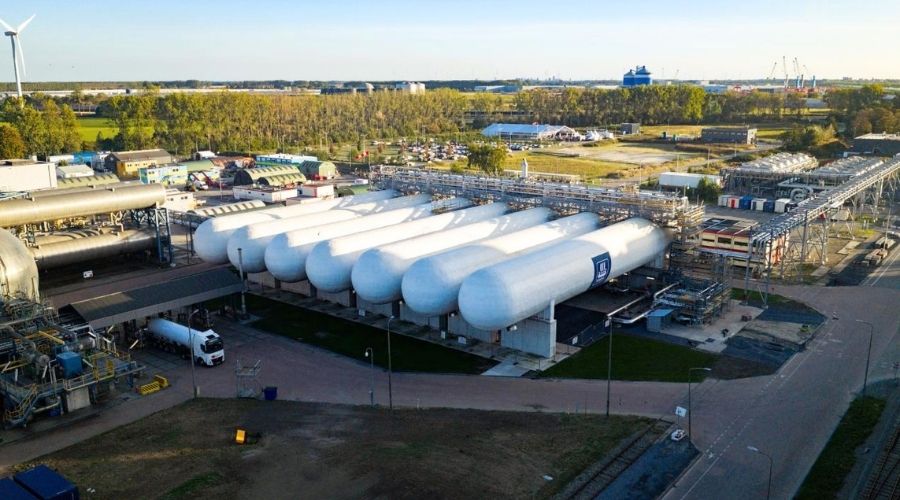
Europe’s largest industrial carbon capture facility has been officially inaugurated at Yara’s fertiliser plant in Sluiskil, the Netherlands. The project establishes the first complete cross-border value chain for capturing, transporting and permanently storing CO₂, with the potential to support lower-carbon fertiliser production for agriculture.
The project provides a practical example of how cross-border CO₂ transport and storage could support industrial decarbonisation across Europe – an issue of growing importance to the UK as it develops its own carbon capture, transport and storage infrastructure, Yara explained.
President and CEO of Yara International, Svein Tore Holsether, who attended the launch together with Norwegian prime minister Jonas Gahr Støre, Dutch prime minister Rob Jetten, European commissioner for climate, net zero and clean growth Wopke Hoekstra, said that was an important day for Yara and for European industry.
“The carbon capture facility in Sluiskil proves that large-scale industrial decarbonisation is possible today.
“As global competition intensifies, Europe must find ways to cut emissions while keeping industry, jobs and critical value chains in Europe. That is exactly what this project is about.”
Yara Sluiskil, Europe’s largest ammonia and fertiliser plant, can capture and liquefy up to 800,000 tonnes of CO₂ annually from ammonia production, thereby avoiding carbon taxation on these volumes. The CO₂ will be transported by ship to Norway, where it will be permanently stored beneath the seabed by the Northern Lights, a carbon capture and storage (CCS) company.
Climate ambition combined with a strong and resilient industrial base
The project is particularly relevant to the UK, where carbon capture and storage is expected to play a key role in decarbonising hard-to-abate industrial sectors while supporting industrial clusters, jobs and investment.
Yara said that the Sluiskil model demonstrates how CO₂ can be captured at an industrial site, transported across borders and permanently stored offshore.
With the right framework conditions in place, the project is expected to capture and store around 12 million tonnes of CO₂ over the next 15 years, making a significant contribution to European climate goals and industrial transformation.
European commissioner for climate, net zero and clean growth, Wopke Hoekstra, said: “Europe needs practical climate solutions that deliver real emissions reductions while strengthening industrial competitiveness.
“The carbon capture and storage project at Sluiskil shows what is possible when innovation and cross-border cooperation come together. This is exactly the kind of project Europe needs to combine climate ambition with a strong and resilient industrial base.”
For UK policymakers and industry, the project offers a tangible example of how international CO₂ transport and storage networks could complement domestic carbon capture infrastructure and help unlock investment in industrial decarbonisation.
Yara said that CCS enables further reduction of the carbon footprint of its production and supports low-carbon value chains across agriculture, industry, energy and shipping, including low-carbon fertilisers to support more sustainable food production, low-carbon ammonia for industrial applications and clean energy solutions and low-carbon fuels for the maritime sector.
Benefits for British farmers
Yara explained that fertiliser produced using PCCS is expected to carry some additional premium due to the new technology cost compared with conventional fertiliser, particularly during the early years of production. However, the premium paid by British farmers is likely to be moderated by market competition, scale efficiencies and evolving carbon policies, with the potential for the price gap to narrow over time.
“For some growers, any additional cost could be offset, and potentially exceeded, by value chain incentives, premiums or preferred supplier arrangements from food and drink processors looking to reduce the carbon footprint of agricultural raw materials and meet their sustainability targets,” a spokesperson for the company said.
What is more, Yara said that British farmers can expect lower-carbon fertiliser produced using PCCS to become commercially available in the UK from Q4 this year, marking an important milestone in the transition to lower-carbon crop nutrition.
While initial volumes should cater for the current market demand, supply is expected to increase as production capacity expands and adoption grows across the agricultural sector. British farmers could begin to see increasing volumes of lower-carbon fertiliser produced using PCCS from 100’s of thousands to millions of tonnes in the very near future.







Leave a Reply