


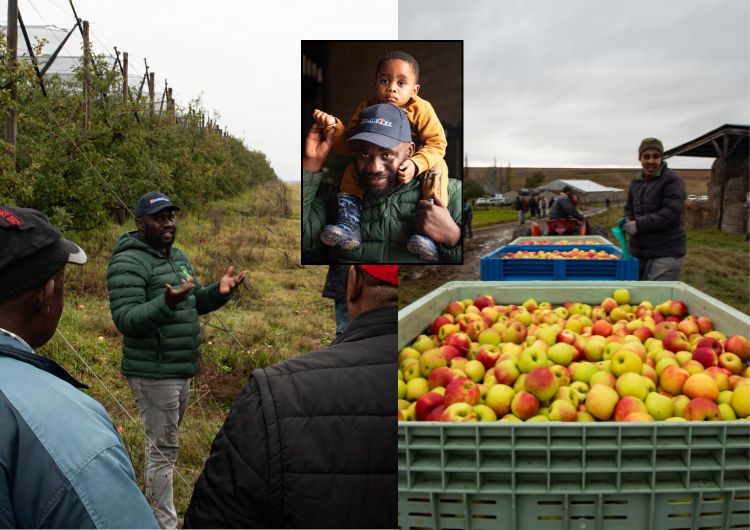
Due to realising that he loved farming he eventually became the owner of Stead Farm, 14 kilometres outside Bethlehem. And because he passionately believes in the future of South Africa, which means he wants to help more South Africans to share in this dream, he is now a shareholder of a farming business operating on Stead Farm.
Introducing Pitso Sekhoto. He is the chairman of Remmoho Investments in Agriculture (RIA) and a prominent leader in South African agriculture, specifically focusing on transforming the Free State sector through apple farming. He leads a 100% black-owned enterprise driving employment and innovation in the Thabo Mofutsanyana district.
“I realised that Pitso is very driven, doesn’t take no for an answer or gets disheartened. He just knocks on doors and kicks them open until he gets what he wants. An awesome entrepreneur. He is the right person to have as a partner.”
Pitso is aiming to significantly boost the GDP of the Free State and to create up to 500 jobs as soon as possible. Sounds like another apple guru, doesn’t it? But if your belief is in apples, anything is possible.

There was a high-level farmers’ day held on Wednesday, 30 April 2026 at Stead Farm, Bethlehem where Remmoho CEO Phuti Kubushi said that at present the Western Cape might be the primary producer of apples in SA, but they are struggling with adequate land and water.
“Our environment and climate allow us to add to what they are doing in the Western Cape because we have plenty of land and water from Lesotho. We want to change the perception that the Western Cape is the leader in apple production.”
To prove the point about abundant water, the farmers’ day was a murky, muddy wet affair, but while it deterred some invitees, a handsome crowd came to listen and learn. Everybody loves a good news story.
The orchard tour
After the official opening and interesting keynote addresses by the leaders of Remmoho Investments in Agriculture, the rain abated significantly for the orchard walk to take place. Karabo Matshele, assistant manager of Stead Farm (and Pitso’s son-in-law) as well as Pitso himself explains the story of the old and the new orchards.
The time range between old and new is from 1999 to 2025, and the main differences between the old and the new are, firstly, that the new orchards’ rootstocks are more dwarfing than the old. The new orchards have a higher planting density (3 300 trees per hectare versus 1 664). That is 3 m between rows versus 4 m and 1 m between trees versus 1.5 m.
The new orchards have been planted with the latest cultivars, such as Lady-in-Red, Buks Gala, Bingo Gala and Fuji Royal. These cultivars have better colour development, so a higher Class 1 pack-out should be achieved, and hence a higher income per hectare.
The new orchard has a drape-net system versus the conventional hail-net system of the old orchard.
On pruning – before employees are allowed to do too much detailed pruning, they let them focus on one function at a time. The new orchards will need even less pruning as the trees will not be allowed to grow as big as the older ones. They will also need to do less work on ladders, which are time-consuming to move around.
The pack house visit
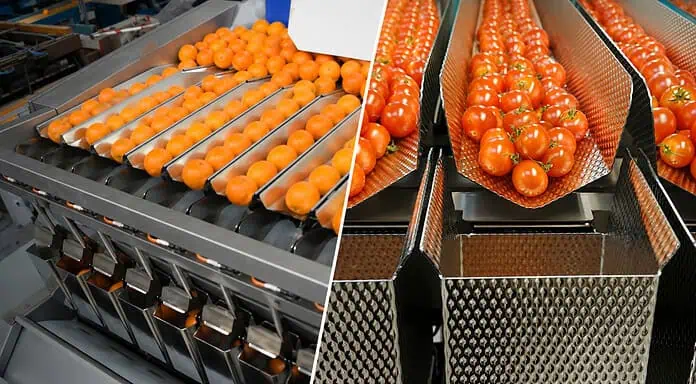
Stead Farm uses the Maluti pack house that has been in operation since 2001, a few kilometres from the farm. They expect to pack 8 000 tonnes of apples this season. The sorting and grading are done by a French-made Maf Rhoda machine that has the latest electronic and optic equipment. Packing is done by hand. Quality is assured by checking samples of packed cartons on a continuous basis. Safety protocols have been developed over years and are continuously improved. This includes regular training of employees.
Roughly 50% of the fruit are exported, and the balance goes to local supermarkets and municipal fresh produce markets. No juicing plant exists in the area. However, they have a strong hawkers market that buys most of the low-quality fruit that could have been juiced. The cultivars being packed are Gala types (Royal Gala, Royal Beaut, Bingo Gala and Buks Gala), Early Red One packed as Top Red, African Red, Fuji, Cripps Pink types packed as Pink Lady, Rosy Glow and Lady-in-Red, and Cripps Red.
The only heritage variety they grow and pack is Granny Smith, and these are only grown for cross-pollination purposes. They fetch a much lower selling price than the main cultivars as mentioned above, because the new cultivars are much better tasting. They do not grade according to texture or taste; however, it may become a requirement in future.
Remmoho Investments in Agriculture is a standout example of what new-era producers are building in the Free State.

What new-era producers entering the industry should know about the challenges and opportunities in apple farming in the Free State: “New-era growers should keep up to date with changes in the industry by employing the best consultants in their orchards and pack houses. New growers in the industry have the opportunity to start their farms with the latest cultivars and orchard design with regards to rootstocks, planting density, net system and irrigation. Challenges like climate, pests, etc. are the same for all types of growers,” says Pitso walking into one of his orchards with his grandson in tow.
In fact, wherever you see Pitso, this hard-nosed business driver, you’d often see him with one or more of his grandchildren. Hand-in-hand or on his lap. They make a beeline to him, and he to them. Should you ask him about it, the answer is simple. “Farming is a family business. The apple doesn’t fall far from the tree, does it?”


Leave a Reply